The handover gap is not your imagination.
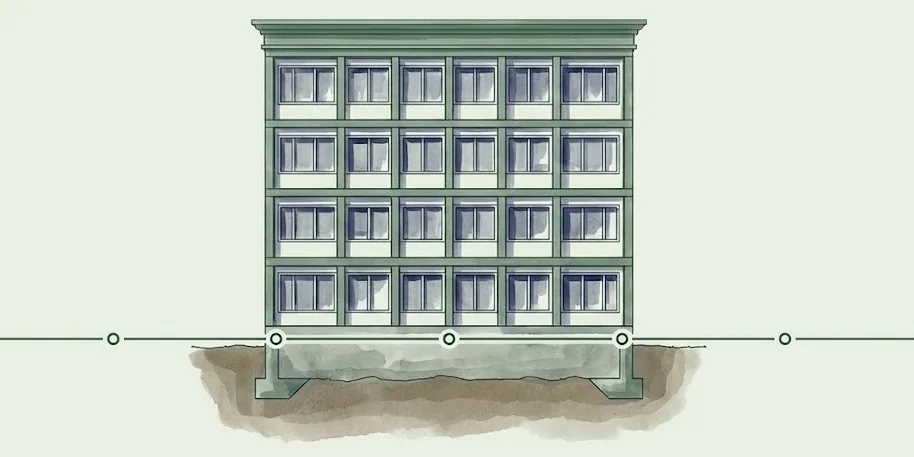
Construction productivity has grown by 0.4 per cent a year since 2000, against 2 per cent for the wider economy and 3 per cent for manufacturing. The numbers are McKinsey's, not ours. The diagnosis is industry-wide. The cause sits squarely at the handover.
In their 2024 report on construction productivity, McKinsey and Company name "fewer and better handovers" among the foundational measures the sector has to fix (McKinsey and Company, 2024). RICS, in its 2025 Sustainability Report, points to the same problem from the asset side. The green premium softens, then disappears, every time a scheme moves from the people who structured it to the people who build it (RICS, 2025).
This is not a coordination problem. It is a control problem. Capital prices sustainability features as risk and quietly discounts them out of the deal. Contractors build to whatever the brief still asks for, and no further. The scheme gets handed over, and the premium that justified the structuring is gone. Nobody acts in bad faith. The system rewards the trim. The household, the operator, and the eventual buyer carry the difference in performance for thirty years.
The operator-partner model removes the handover. The same accountable team that structures the financing also signs off the build. There is no point in the process where one party can drop a sustainability target because the next party never owned it. The integration is not a service line, it is the company.
This is not theory. We built the operator-partner platform across three continents starting in 2007, because the integrated route was the only one we could verify from the inside. We carry capital alongside our partners, so the structuring is our exposure too. We deliver, audit, and operate, so the brief and the building stay aligned.
The first three filters are honest. The opportunity passes asset, market, and demand, or we walk. The brief is then defined against scope and standards before any term sheet is drafted. The capital stack is structured to make the standards a financing term, not a marketing line. Delivery is then a question of execution, not negotiation. By that point, the standard is locked into the document the contractor is paid against.
Across the 2017 to 2025 reporting window, the schemes we structured this way returned a 10 to 14 per cent premium on the conventional comparator, audited internally year on year. The methodology is available to qualified counterparties under non-disclosure. The audit cycle that produced it carries five stages, the same team across all five: structuring, design pack, build, commissioning, and operation. It is the continuity of the team that did the work, not a process diagram.
The public-market test of the same thesis was a nine-figure sustainability-linked bond, priced inside vanilla debt of comparable tenor and rating. The bond is the discipline that the integrated model paid for. When the market priced the structuring at the same level as the unstructured paper, the operator-partner model met its hardest external test. The scale of the conviction is now routed through GREAP, the multi-billion diversified investment platform we structured around real estate, green energy, and a global merger and acquisitions programme.
The figures matter less than the lesson under them. None of this works in pieces. The capital decision and the delivery decision have to sit under one accountable team, or the standard quietly leaves the brief on its way to handover. The audit at completion has to read against operational performance, not against the brochure.
For landowners and councils with sites that need a sustainability-led operator, the question is whether the people structuring the deal are also the people who will deliver it. For joint-venture capital, the question is whether the operator is exposed to the same outcome you are. For institutional landlords planning to hold long-term, the question is whether the standard your asset will be valued against at refinance is the same standard it was built to. Each of these questions has a structural answer, and the answer determines whether the handover gap closes or stays open on your scheme.
The recommendation is short. Treat sustainability as a financing term, not a marketing line. Treat the handover as the place to remove, not the place to manage. Treat the operator as a partner exposed to the outcome, not a contractor exposed to the cost.
The reflection is shorter. We are not the only platform that thinks this way. The McKinsey diagnosis and the RICS evidence are public. What we did was take real financial risk on the conviction while the profit and loss and the board temporarily disagreed, until the audited returns confirmed the structuring. The blueprint is open. The next step belongs to whoever wants to use it.
McKinsey and Company, 2024. Delivering on construction productivity is no longer optional. Available at: https://www.mckinsey.com/capabilities/operations/our-insights/delivering-on-construction-productivity-is-no-longer-optional
RICS, 2025. Sustainability Report 2025. Royal Institution of Chartered Surveyors. Available at: https://www.rics.org/content/dam/ricsglobal/documents/reports/Sustainability-report-2025.pdf
Technical Methods Limited, 2026. Sustainability Data Sheet v1. Available at: assets/docs/sustainability-data-sheet.pdf
Rami Saadi
CEO