Sustainability, Priced Not Labelled
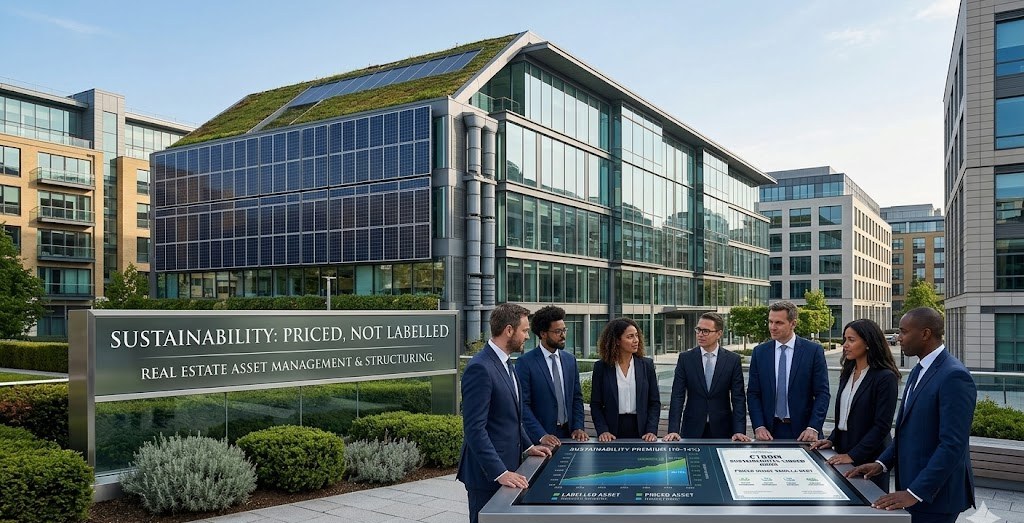
For two decades the market treated sustainability as a label. We treated it as a price. The gap between those two positions is the whole story.
A label is a claim added to an asset after it has been structured. A price is a number the structure was built to produce. A label costs nothing and changes nothing. A price has to be earned, defended, and proved. We took the second position, structured sustainability as a price from the start, and waited for the returns to confirm the conviction. They did.
Since 2017, sustainability-led structuring has produced a 10 to 14 per cent premium on returns across our portfolio, audited year on year. The premium did not come from a label. It came from a model. The same team that structures the financing also signs off the build, so the sustainability features specified at the start are the features that survive to completion. The building runs at lower cost, performs to the standard it was designed for, and holds its value because the performance is real.
Internal data is evidence on our own terms. The harder test is whether the same conviction holds when it is priced by people who owe us nothing. That test was a nine-figure sustainability-linked bond priced inside vanilla debt of comparable tenor and rating.
A sustainability-linked bond is not a soft instrument. Its terms are tied to sustainability performance, which means the issuer is exposed if the performance does not materialise. A bond like that is only priced well when the market believes the sustainability outcomes are genuine and deliverable. Ours was. The bond is the public-market evidence that the integrated model produces sustainability outcomes credible enough to carry into a regulated debt instrument.
Scale is the third piece of evidence. The multi-billions routed through GREAP, the diversified investment platform we structured around real estate and green energy, are the proof that this approach is not limited to a handful of schemes. Capital does not route multi-billions through a structure it does not trust to deliver.
The shift is not in our numbers. It is in the market around them. Buildings structured for sustainability are demonstrating lower running costs, stronger occupancy, and more durable values. Regulation is tightening around environmental performance, which turns a sustainability gap into a future liability that capital now has to price. Institutional landlords are starting to discount the assets that do not perform.
We are not claiming credit for that shift. We structured for it early, ran on the conviction while the board and the wider market disagreed, and now have audited returns that show the conviction was correct. The 10 to 14 per cent premium is what it looks like when sustainability is priced properly rather than labelled cheaply.
A label is cheap because it delivers nothing. A price is expensive because it has to deliver something. We chose the expensive position because it is the one that produces a real return and a real building. The conviction came first. The audited premium, the bond, and the multi-billions through GREAP came second. The market is now arriving at the same place.
Rami Saadi
CEO